
Blog · October 2026 · 8 min read
How photography and creative freelancers should structure their invoices
A photographer sends an invoice for a day of shooting and a client asks why it is higher than the quote. A designer bills for a logo and the project manager cannot tell the creative fee from the printing costs. Neither problem is about money. Both are about structure: the work and the costs arrived on one line, and someone had to guess which was which. This is how a freelance photographer invoice template should be built, and how the same structure carries over to design, video and every other creative discipline.
What the invoice is really being read for
The person paying rarely hired you. An office manager, a procurement team or a partner opens the document against a purchase order and a policy, and their job is to check that the numbers add up and that each one is allowed to be there. Everything you do creatively before this point is invisible to them. The invoice is where the engagement becomes a set of lines that either make sense in ten seconds or invite an email.
Creative work makes this harder than consulting or contracting, because a photography invoice mixes three different kinds of number: a fee that is yours and not open to itemisation, products that have a unit price, and costs you are passing through. Blending them is what causes arguments. Keeping them apart is the whole structure.
The seven blocks of a creative invoice
Every freelance photographer invoice template worth using has these in this order:
| Block | What goes in it | Why it is here |
|---|---|---|
| Your details | Business name, address, email, phone, tax ID | Matches what procurement already has on file |
| Client details | Legal name and billing address, plus their reference | Their purchase order number is often required for payment |
| Number and dates | A unique number, issue date, due date | Lets both sides find the document again later |
| The work | Creative fee, then products and extra hours | The fee is argued only when it shares a line with costs |
| The pass-throughs | Travel, assistant, rental, overtime as their own lines | Checkable against an expense policy in seconds |
| Terms | Licence granted, usage, delivery conditions, notes | They pay on the same document that says what they bought |
| The money | Currency, subtotal, tax, total, how to pay | The amount column must agree with the printed subtotal |
The creative fee: one line, never blended
Charge it the way the job was sold. A single session or event is a flat fee with a quantity of one. A full day of shooting or filming works as a day rate. An open engagement, retouching or ongoing social work is cleaner by the hour. All three are just a quantity and a rate on a line, and the invoice does not care which you picked.
The point is that the fee stays alone. Once you write "photography including prints" you have handed the client a single number they can push on from either direction, and you have lost the ability to show that the creative work and the products were separate decisions. Keep the fee on its own line, describe it plainly, and let the products sit underneath it with their own quantities.
If you work across disciplines, the saved services library in the app already carries the shapes most creatives use: Photography session at 300 per session, Videography at 800 per day, Video editing at 60 per hour, Graphic design at 55 per hour, Logo design at 250 per project and Brand identity at 900 per project. Each inserts as a line with its quantity, rate and tax already set, which is how a mixed invoice gets built in a minute instead of reconstructed.
Products: prints, albums, and anything with a unit price
Prints, albums, physical goods and second shooters are quantity lines. They need a unit price, because a client comparing a print order with the price list you sent earlier can only do that if each item has its own quantity and rate. Itemising them protects the creative fee rather than weakening it: the client stops treating the fee as a bundle and starts reading it as the part they hired you for.
This also handles the awkward case where a client asks for a discount on the products but not on your work, or the reverse. A percentage discount can sit on the line it applies to, so you are not recalculating the whole invoice to grant one small concession.
The licence line that most creatives leave out
A photograph delivered is not necessarily a photograph purchased outright, and the invoice is the natural place to record what was granted. Put it in the terms field: how long the client may use the images, in which channels, whether the usage covers paid advertising, and whether you may keep the work in your own portfolio. Two or three sentences is enough.
Doing this at payment time rather than in a separate contract means the terms travel with the money. If the client later runs the image in a campaign the licence never covered, you have a dated document with their payment on it. The same field carries a credit note's link back to the original invoice when a shoot is cut short, and it is where delivery conditions belong: when the gallery ships, and what has to be settled before it does.
Costs: pass them through, but never inside the fee
Travel, mileage, parking, an assistant, a stylist, studio rental, prop purchases, rush delivery and any fee your bank charges to receive the payment all go on their own lines below the creative work. Three reasons, in order of importance:
- They are checkable. An approver can tick them against a policy without calling you.
- They are negotiable separately. A client can accept your fee and question a taxi, which is a much better conversation.
- They are recoverable. Costs folded into a fixed fee silently eat your margin every time the job runs long.
Destination work is where this decides whether a shoot was profitable. Mileage and accommodation as lines turn a travel day into a billable document instead of a cost you absorbed because it felt awkward to add.
Deposits, balances and receipts
For weddings and bookable sessions, the standard is a deposit of 30 to 50 percent to hold the date. Invoice it as its own document with its own number when the date is booked, so the reservation exists in writing rather than in a message thread. Then invoice the balance with a due date that falls before delivery of the gallery or the final files.
When money actually arrives, issue a receipt. Receipts are their own series, they record how the payment was made, and their total is the amount paid rather than an amount still outstanding, so a deposit receipt can never be mistaken for an unpaid invoice. On the main invoice, mark it partially paid when the deposit has been applied and paid when the balance lands. That single habit is what stops a half settled shoot being chased for the full amount.
When to send it
- The day the work is delivered or accepted. Fresh invoices get approved with that week's paperwork.
- Write the due date as a date. "Due 14 November" beats a payment phrase that means something different to every reader.
- Put a payment link on it. A Stripe, PayPal or Mollie link removes the exchange where someone asks for your bank details and waits.
- Carry their reference. If the client gave you a purchase order number, it goes in the reference field or the invoice may never reach the payment run.
- Use the status field honestly. Draft, sent, partially paid, paid, overdue. A weekly look at what is marked overdue is where the unpaid creative work usually hides.
- Number in sequence. Invoices, quotes and receipts each increment on their own, so nothing is ever duplicated and any document can be found by its number.
What delays a creative invoice
- One line reading "photography services" with no fee, quantity or date behind it.
- Prints, travel and retouching buried inside the creative fee.
- No licence, no usage terms, and a client who assumed something else.
- An invoice sent two weeks after delivery, when the person who approved the work has moved on.
- The deposit recorded nowhere, so the balance invoice looks like the full price.
- A missing tax ID or a business name that differs from the contract.
- A total that does not agree with the subtotal printed under it.
- No due date, no terms, and payment only possible by asking for bank details.
Which document to send when
Creative jobs generate more paperwork than a shoot alone, and the document you send sets the expectation that follows:
- Quote before the work starts, when you are committing to a price for a defined scope. It carries an expiry date.
- Estimate before the work starts, when the deliverables are clear but the hours are not.
- Invoice when the work is delivered, carrying a due date and the licence terms.
- Receipt when a deposit or the balance lands, recording how it was paid.
- Credit note when a shoot is cancelled after part of it was billed, pointing at the invoice it reverses.
- Purchase order when you are hiring a second shooter, stylist or studio on the client's behalf.
- Delivery note when the files, album or prints physically hand over.
See quotation vs estimate vs proforma for the difference between the three pre-work documents, and how receipts work for what a receipt has to show.
A freelance photographer invoice template you can start from
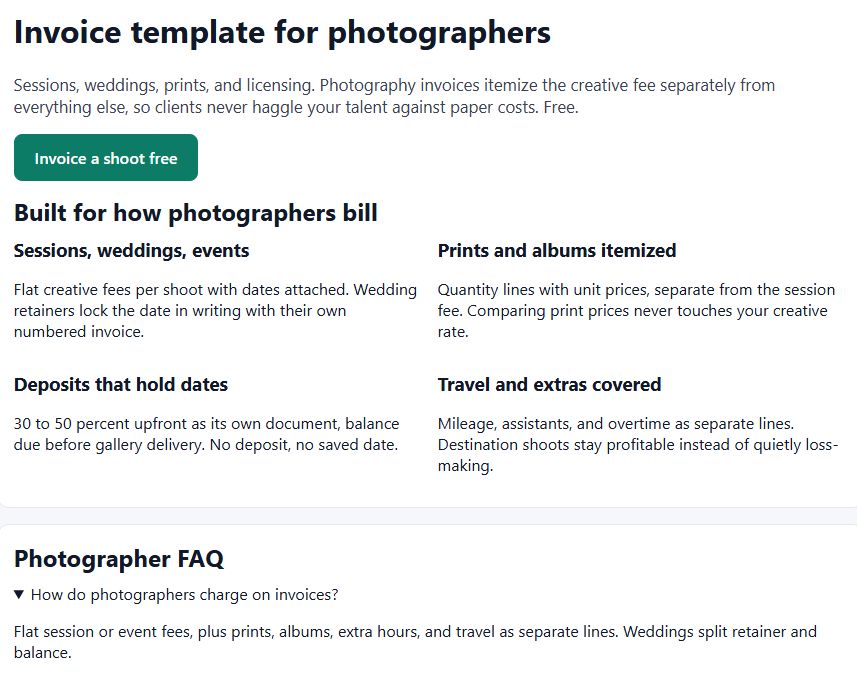
The photographer invoice template is built for exactly this structure: flat creative fees per shoot with dates attached, prints and albums as quantity lines with unit prices, deposits that hold dates as their own numbered document, and mileage, assistants and overtime as separate lines. The designer template and the freelance template use the same shape for branding, logo and general client work.
The app behind them runs entirely in your browser with no account and no watermark: 12 templates, 9 languages including right to left Arabic, 6 currencies, and 12 document types from invoice and quotation to credit note, purchase order and delivery note. Line items carry quantity, rate, discount and tax, with a document level discount applied before tax so the printed subtotal stays honest. Duplicate a document instead of rebuilding it, convert an accepted quote into an invoice in one click, and export everything as a JSON backup. Files leave as PDF with selectable text across multiple pages, or as Word, PNG and CSV. Nothing you type leaves your device, and the nine elements every invoice needs covers the checklist version of this page.
Creative invoice FAQ
What is a freelance photographer invoice template?
A reusable layout that separates the creative fee from products, licensing, travel and taxes, so the client can see what they paid for. You fill in the shoot details, add the lines, and download a numbered PDF instead of rebuilding the document each time.
How much deposit should a photographer take?
Commonly 30 to 50 percent to reserve the date. Invoice it as its own document with its own number so the booking is recorded in writing, then invoice the balance with a due date before the gallery is delivered.
What line items should a photography invoice have?
The creative fee first, then any prints, albums or additional hours, then travel and assistant costs as their own lines, with tax and the total underneath. Keep the creative fee alone on its line so nobody argues the price of your work against the price of paper.
Should licensing and usage be stated on the invoice?
Yes. Put the licence you granted in the terms or notes field: how long the client may use the images, where, and whether you may use them in your own portfolio. It sits on the same document they pay, so there is no later disagreement about what was bought.
When should a creative freelancer send the invoice?
The day the work is delivered or accepted, with a due date written as a date. For a wedding or a large shoot, invoice the deposit when the date is booked and the balance before delivery, so payment and handover stay tied together.
Can I invoice photography, design and video work on one document?
Yes, and for a mixed creative client it is clearer. Each service gets its own line with its own quantity and rate, so a shoot, an edit and a set of graphics are visible as separate work rather than hidden inside one invented total.
Make a photographer invoice free
No sign-up, no watermark, nothing leaves your browser.